
Prime vs Supreme: Which Is Right For Me?
HOW-TO & GUIDES
Browse the Shark Store and every guitar carries one of two words: Prime or Supreme. Open the 3D Designer and you meet the same fork at the electronics step. It is easy to assume Prime is the basic version and Supreme is the full one. That is the most common misread, and the first thing to clear up.
Prime and Supreme are two different electronics designs, built around two different ideas of where your sound should be made. Neither sits above the other, and the guitar around them is identical either way. This guide walks you through the questions that actually decide it.
The Short Answer
Choose Prime if you do not want effects on board and like the guitar lean and light. Its preamp-style electronics send a clean, full-strength signal to whatever comes after it and give you hands-on control over your pickup tone.
Choose Supreme if you want your effects inside the guitar. Three FX Card slots put analog and digital effects on board, and the whole rig travels wherever the guitar goes.
Everything else, the Convertible Bridge, the Adjustable Fret System, the neck system, the pickup modules, the woods and the finishes, is the same on both.
If that already settled it, the Store and the 3D Designer are waiting. If not, three questions usually decide it.
Three Questions That Decide It
1. Do you want effects on board?
This is the real fork, and it is not about whether you already own effects. Supreme puts real effect circuits, analog and digital, inside the guitar, and that works as an addition to a setup you already run: a pedalboard with no room left, a board you would rather not grow, or a processor whose menu does not have that one sound you want. Prime is the opposite call: no effects in the guitar, by design. It sends a strong, uncolored signal out, so whatever comes after it works from the best possible foundation.
2. How hands-on do you want your pickup tone?
Both systems sense whether each pickup is a humbucker or a single coil and balance the loudness between them automatically. The difference is who sets the level. On Prime, you set it yourself from the front knobs, and the compensation circuit is deliberately open to adjustment, which is why Prime can pull genuinely different tones from the same set of pickups. On Supreme, it comes preset: pick a level with the DIP switches and it just works. Tweakers lean Prime. Set-and-forget players lean Supreme.
3. What do you carry to a gig?
If everything needs to fit in one bag, Supreme keeps the whole chain inside the instrument. The sounds you rely on travel inside the guitar, set the way you left them, so a fly date or a drop-in session no longer means hauling and repatching a board. With Prime, the guitar is the cleanest possible front end for whatever rig is waiting at the venue.
A Closer Look at Prime
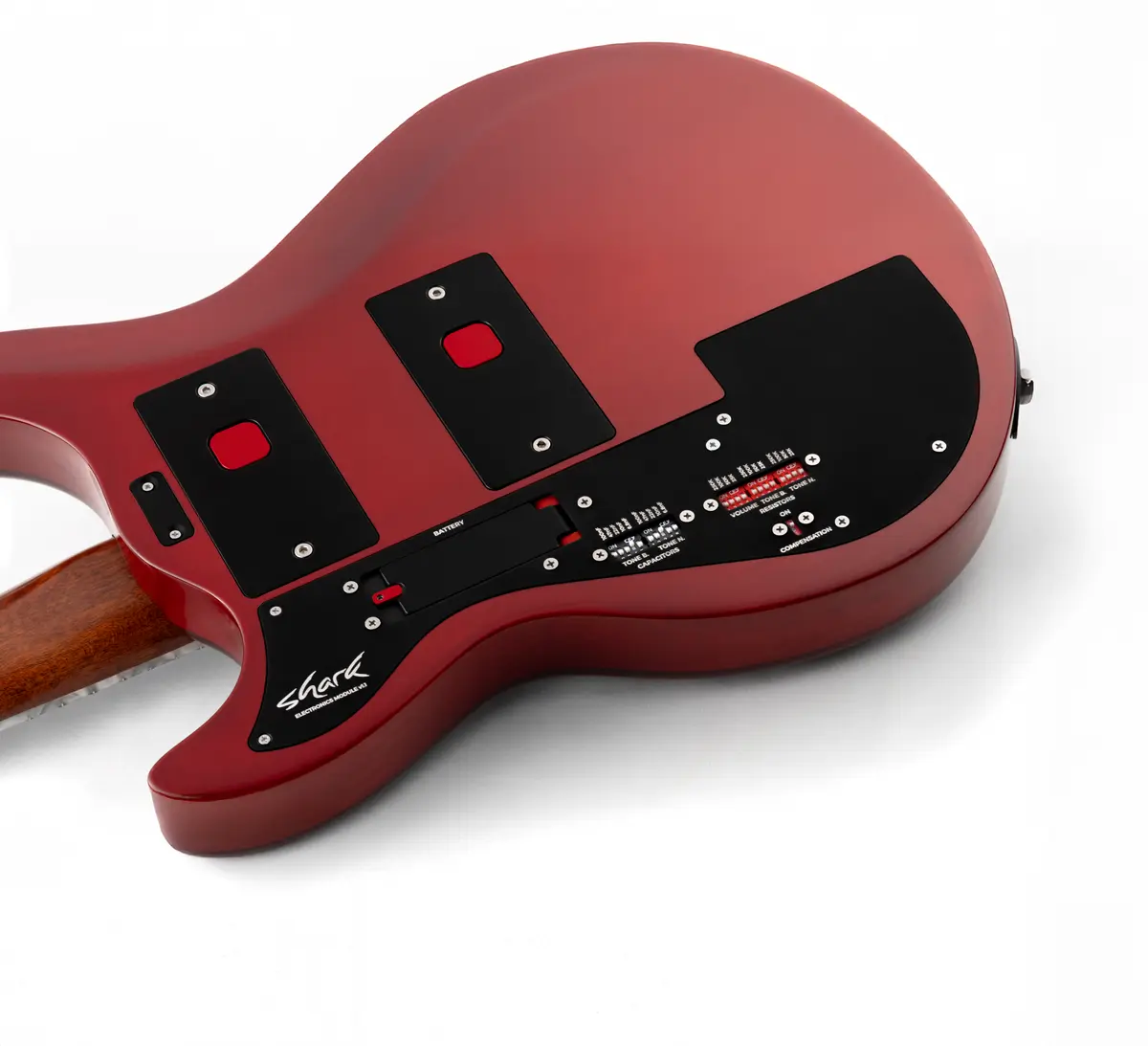
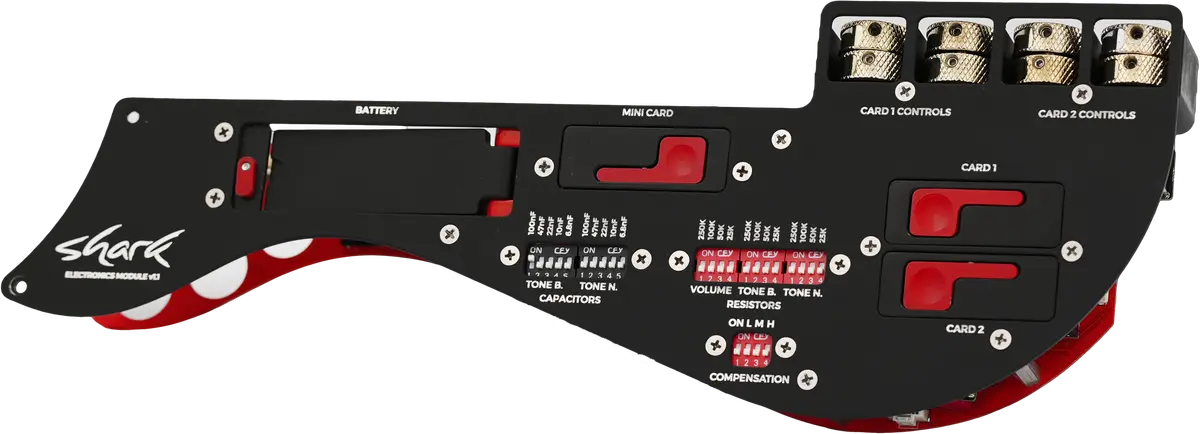
Prime is the full Shark with simplified controls, not a reduced one. Its electronics have a preamp-like structure: they condition and strengthen your signal inside the guitar, before a single cable can color it. Your gain staging starts from a clean foundation instead of making up for a weak front end.
The front panel stays simple, four knobs and three switches, with the deeper shaping on DIP switches at the back, where the tone circuit adjusts to match any pickup you mount. And because the compensation system is hands-on and editable, Prime uses pickups more flexibly than traditional wiring does. Combined with changeable pickups, Prime is a tone enthusiast's dream.
Prime is for players who prefer external effects, value elegant simplicity, or want deep manual control over their pickup tone.
A Closer Look at Supreme
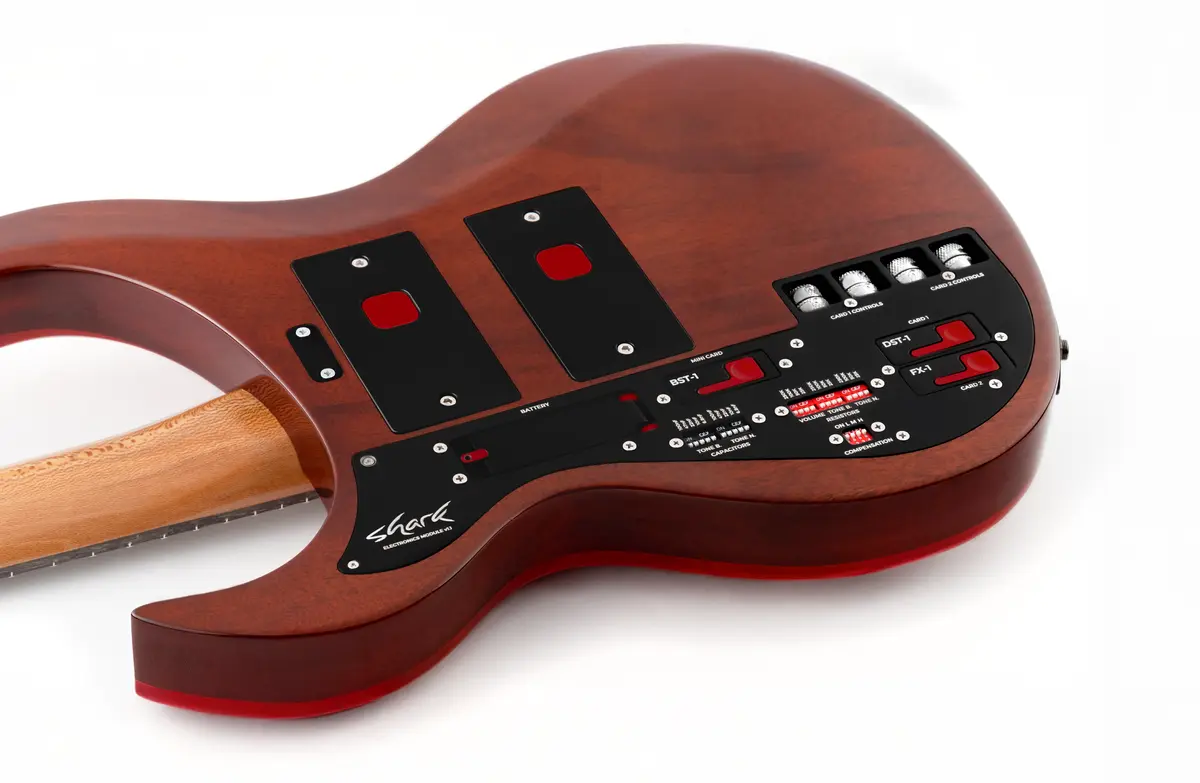
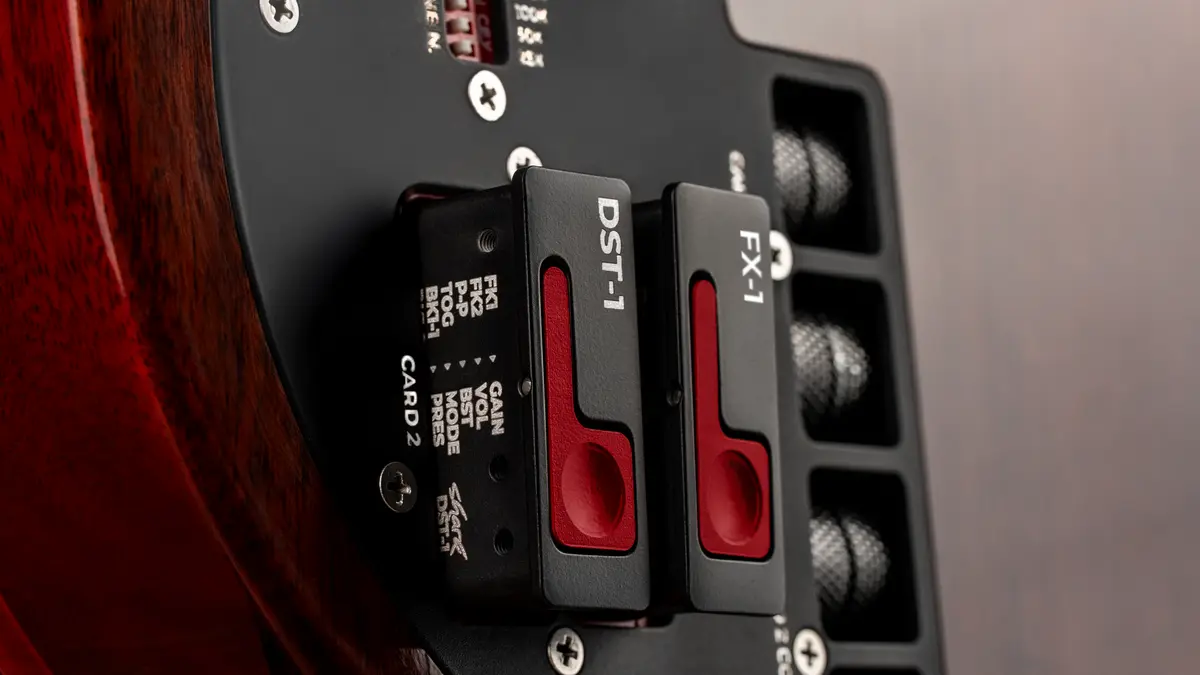
Supreme builds the effects into the guitar through Shark FX Cards: real effect circuits, analog and digital, rebuilt in card format. There are three slots, two standard and one mini. Cards slot into the back panel and process your signal in a short, shielded path, so a full effects chain runs without a single patch cable, and any card swaps out in seconds. And it does not have to replace anything: the cards sit just as comfortably alongside a board or processor you already use, carrying the sounds they do not.
The controls grow to match. The front panel adds dedicated effect controls and bypass buttons, four gang knobs (stacked dual controls), three switches, and four buttons, and the back panel adds eight roller knobs for fine-tuning each card. Pickup compensation comes preset: choose a level with the DIP switches and play.
Supreme is for players who want onboard effects, maximum versatility, or prefer carrying the entire rig in the guitar itself.
What You Get Either Way
The choice is narrower than it looks, because the shared foundation is most of the guitar. On every Shark, Prime or Supreme, the Shark Electronics module sits in a shielded enclosure on the back of the body and routes pickups, tone, and power through one clean internal signal path:
Smart pickup management. The system senses humbucker or single coil and balances loudness between pickup types, so switching never hits you with a volume jump.
Deep tone shaping. DIP switches adjust the tone circuit's capacitor and resistor values, shaping brightness, warmth, and knob response for whatever pickups you mount.
Built-in treble bleed. High-frequency clarity survives when you roll the volume down.
Any pickup, any type. Single coils and humbuckers, passive and active, with humbucker splitting on board.
A shielded enclosure. Stage lighting and venue wiring stay out of your signal, even at high gain.
Motion-sensing power. One 9V battery runs the system. A motion sensor cuts power when the guitar rests and wakes it the instant you pick it up, and a longer-lasting rechargeable Li-ion option is available too.
On both, the signal path itself is the quiet advantage: everything happens on one motherboard, through direct circuit paths, with near-zero signal loss. What leaves your guitar is a clear, full-strength signal with your tone intact.
Side by Side
Where the two designs actually differ:
| Prime | Supreme | |
|---|---|---|
| Design | Preamp-style, clean direct signal out | Self-contained, effects on board |
| Onboard effects | None, by design | Analog and digital FX Cards, 2 standard + 1 mini slots |
| Front panel | 4 knobs, 3 switches | 4 gang knobs, 3 switches, 4 buttons |
| Back panel | DIP switches | 8 roller knobs plus DIP switches |
| Pickup compensation level | Set by hand, front knobs | Preset, via DIP switches |
Everything not in this table is identical on both.
Three Things to Know Before You Build
The decision is made when the guitar is built. The electronics module comes with the body and is not sold separately, so a Prime cannot be converted into a Supreme later. If you are torn, the 3D Designer is the place to settle it: build the same guitar both ways and compare.
The name tells you which is which. Every Shark model carries a two-letter prefix: the first letter is the collection, the second is the series. SP - IVORA is a Solid Prime. TS - BRAMBLE is a Truewood Supreme. Once you know the code, you can read any Shark at a glance.
You can re-spec any Store design. Love a Prime build in the Store but want effects on board? Open it in the 3D Designer and swap the electronics: same look, same woods, now a Supreme. Most collections come in both series; two showcase collections, Monarch and Nomad, are currently Supreme only.
The Bottom Line
Prime and Supreme answer one question two ways: how much of your sound should live inside the guitar? Prime keeps it easy by staying out of your rig's way. Supreme keeps it easy by becoming the rig. Both have devoted players, and plenty own both, a Prime for one job, a Supreme for another.
Pick the one that matches how you play today. The instrument underneath is the full Shark system either way.
Browse ready designs in the Store · Build yours in the 3D Designer
Date Edited: 21-09-2026
Date Created: 17-07-2026
TAGSElectronics, How-To