
Universal Pickup Support
Features
Universal is an easy word to put on a spec sheet. It is harder to mean.
On a Shark guitar it has to cover two separate things, and the first one is not worth much without the second. The guitar has to accept the pickup you want to use. Then it has to treat that pickup properly once it is in there.
The Short Version
Mechanically: industry-standard pickups mount onto a Shark Pickup Module using screw terminals. There is no soldering at any point.
Electrically: the guitar reads what you loaded and adjusts to it, rather than running every pickup through one fixed circuit.
The rest of this is what each of those means in practice.
Why Pickups Became Permanent
On a normal electric guitar the pickup is soldered to a fixed harness and buried under the pickguard or the finish. Changing one means opening the instrument, heating solder joints, and hoping nothing goes wrong.
So mostly it does not happen. The pickup bought a year ago is still in its box. The player who needs three different voices in one session ends up buying a third guitar, which arrives with its own permanent pickups, and the same problem starts again one instrument further down the line.
Shark treats that as a design problem rather than a fact of life. Pickups should be a set of sounds you can reach for, not a commitment you make once with a soldering iron.
Part One: It Accepts What You Already Own

The Shark Pickup Module is the carrier. Your pickup mounts onto it once, and from then on that pickup travels as a module.
Mounting is solderless from start to finish. The leads go into the contact terminals, the screws lock them in place, the pickup is secured to the module. The tools for it ship with the guitar.
The module is built around the pickup families players actually have:
Humbuckers, including stacked and blade designs
Strat-style single coils
Active pickups as well as passive
Six-contact connectors are there for pickups that carry more than a hot and a ground, so advanced wiring survives the terminal block instead of being cut down to fit.
Two details matter more than they sound. The pickup's coil wires stay inside the module, so the delicate part of the pickup is handled once and then left alone. And the same carrier serves both neck and bridge positions, so a module is never committed to one end of the guitar.
If you own something unusual and want to check before ordering, ask us by email or through the live chat on the site.
Part Two: The Guitar Adapts to the Pickup
This is the half that the word compatible usually skips. A slot that physically accepts anything is not much use if everything sounds wrong once it is in there. Running a low-output single coil alongside a hot humbucker on the same guitar usually means one of the two is too quiet.
Shark Electronics is built to deal with that:
- It knows what you put in. The electronics detect whether a module carries a single coil or a humbucker and balance their levels, so moving between them does not jump in volume and neither pickup loses its character. How much compensation gets applied stays your decision, set from the front knobs on Prime and from DIP presets on Supreme.
- Knob response follows the pickups. Capacitor and resistor options are chosen from the back of the guitar, so how the volume and tone controls behave is matched to what is actually installed rather than fixed at the factory.
- Humbuckers can be split to single-coil mode.
- Phase is a physical choice. The module fits into the bay either way around. Turn it over and the pickup's phase reverses, with no rewiring involved.
- Height is set per module, with a hex key at the back, so each pickup can be dialled in to its own output and feel.
- Active pickups are powered by the guitar's onboard battery. Nothing external, nothing to route.
- The electronics sit in a shielded enclosure, which counts for most with the single coils that are usually the noisiest thing in a signal chain.
- That is the difference between a mount and support. The guitar is not tolerating your pickup. It is set up for it.
An Open Platform, Not an Approved List
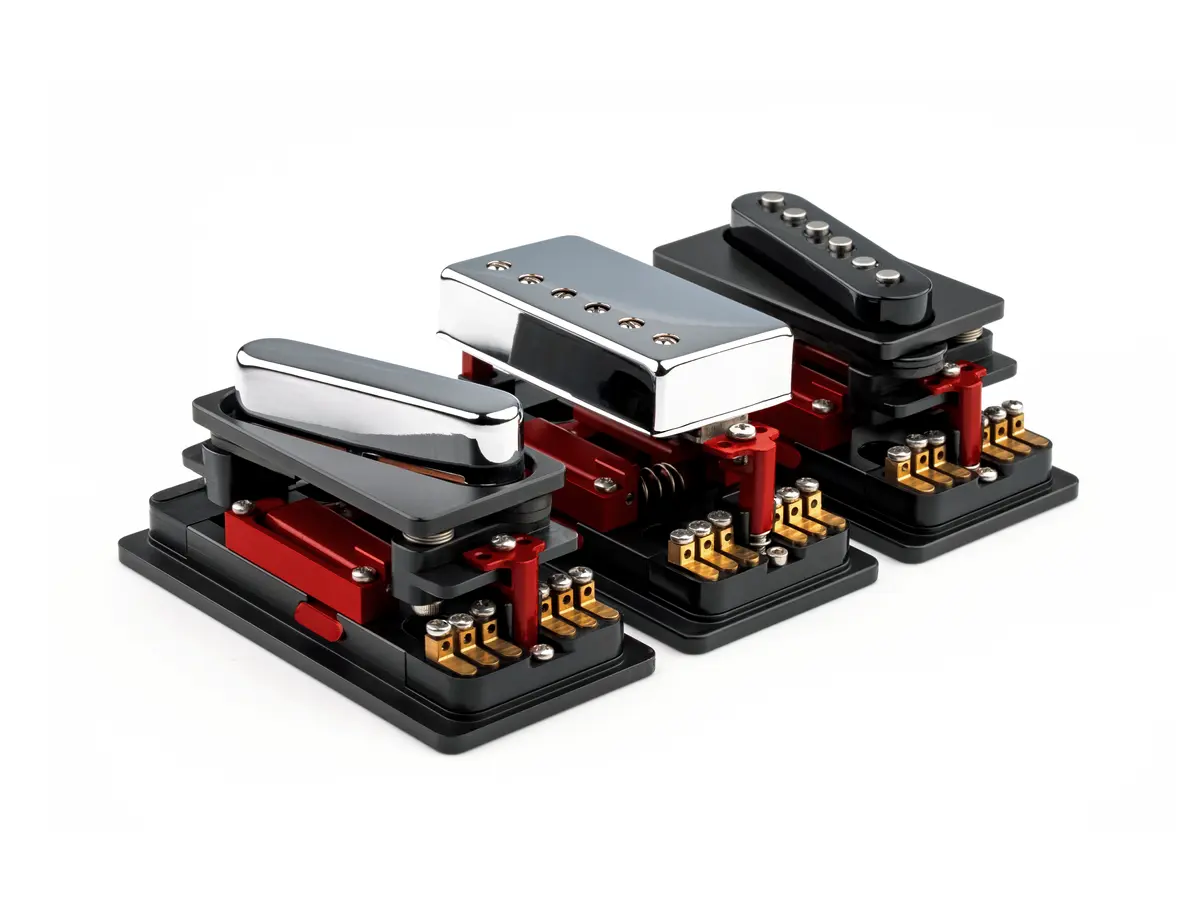
Interchangeable-pickup ideas usually arrive as closed systems. A small set of factory units, rotated between, while the pickups you chose yourself stay in the drawer. The instrument decides what is allowed on it.
Shark works the other way around. The guitar supplies the mechanical platform and the electronics, and what lives on it is your call. Shark's own pickups are one option rather than the price of entry, and the ones you already trust are another. Mount each on its own module and they all become part of the same library.
What It Actually Changes
The pickup that never got installed goes in tonight. Two candidates for a recording get compared back to back instead of argued about. One guitar covers a session that would otherwise have needed two.
And the instrument itself stays out of it. The body, the finish and the main wiring never see heat or repeated disassembly. Only the bay and the modules move, and they were built for exactly that.
The Bottom Line
Universal support means the guitar has no opinion about which pickups you are allowed to like. Mount what you own, and the electronics meet it where it is.
Browse the Store · Build yours in the 3D Designer
Date Edited: 21-09-2026
Date Created: 31-07-2026
TAGSElectronics