

Shark Guitar Care: The Few Rules That Matter
HOW-TO & GUIDES
A Shark guitar invites you to do things you were probably taught never to do: take the neck off, pop the pickups out, slack all the strings at once. So it is fair to ask the quiet question every new owner asks. What could I get wrong?
The honest answer: not much. The system is built to be handled, and almost every part of it forgives you. But there is a short list of rules that genuinely matter. This guide covers them all.
The Bridge: Three Rules Worth Memorizing
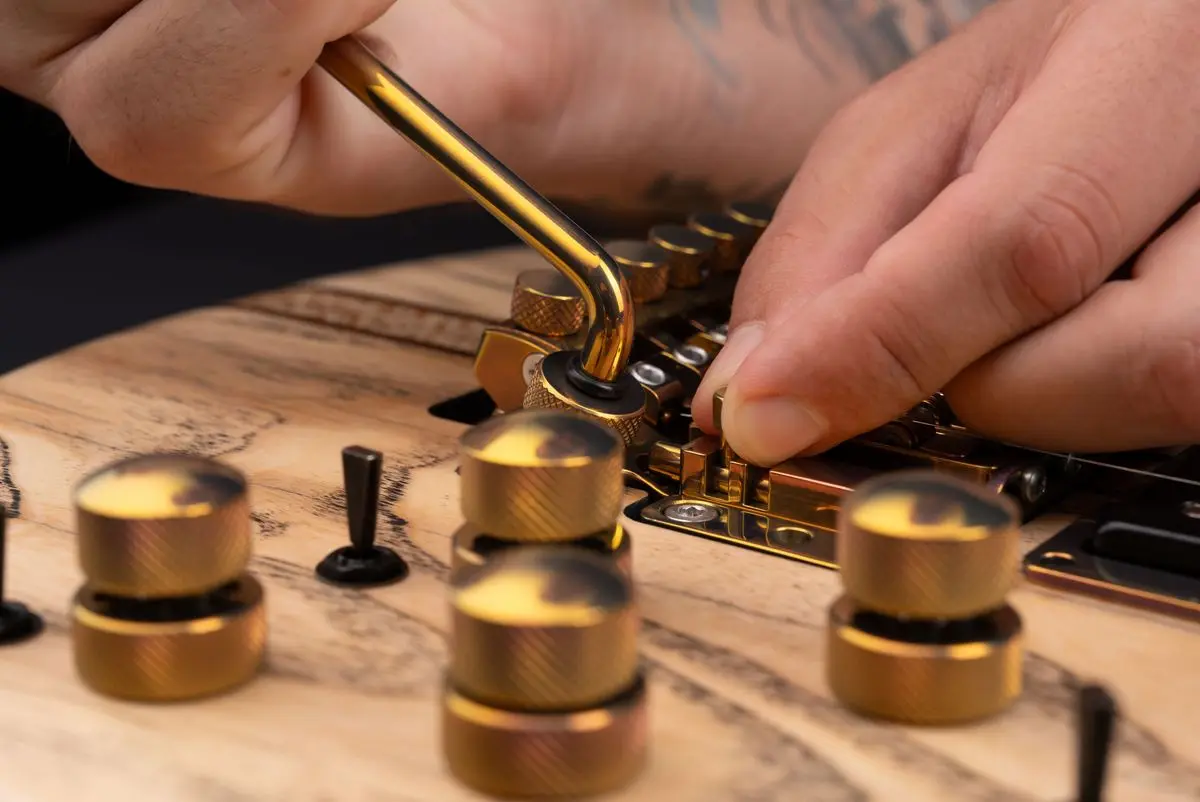
The Shark Convertible Bridge gives you tremolo mode, fixed mode, and a third service position called Maintenance Mode, which locks the tremolo forward so the strings go slack without being removed. It is the key to neck changes, string changes, and travel packing. It is also where the only real "handle with care" rules on the instrument live.
Rule 1: Always enter Maintenance Mode from tremolo mode. If the bridge is locked in fixed mode, pull the slide lock out first. Moving the tremolo arm against an engaged fixed-mode lock puts stress exactly where it should never be, and risks damaging the bridge or the body.
Rule 2: While the guitar is in Maintenance Mode, let the arm rest. The lock is carrying the load the strings normally carry. This means the tremolo arm is not a handle and not a lever right now: do not use it to lift or steer the guitar while you work. Park the guitar flat, do what you came to do, and leave the arm alone until you are ready to exit.
Rule 3: Exit with your hand on the arm, in the right direction. This is the one step on the whole instrument that deserves your full attention. Hold the tremolo arm, lift it slightly toward the pickups to take pressure off the lock, slide the lock out, then lower the arm slowly. The direction matters: the lock releases when the arm lifts, never when it is pressed down toward its playing position. Pressing down, a reflex that has caught our attention more than once, only drives the bridge harder against the lock. And never flick the lock open with the arm free. The stored tension will snap the bridge back hard enough to damage your setup, your strings, or the guitar itself.
One smaller note: the slide lock is spring loaded and catches on its own. If it does not engage, the bridge is not lifted quite high enough. Lift a little more and give the lock a small flick. It should never need force. On a Shark, nothing should: if any latch or lock resists you, the answer is always to check the position, never to push harder.
The full procedure is in How to Engage Maintenance Mode on the Shark Bridge.
Neck and Nut Swaps: Let the Click Do the Work
Changing necks takes about 30 seconds, and the hardware is designed so that every correct action ends in an audible click. That click is your quality control. The mistakes to avoid here are all variations of ignoring it.
Match the fret count. Shark bodies come in 22-fret and 24-fret configurations, and necks pair with their own count: 22 with 22, 24 with 24. This is the one compatibility rule inside the Shark system, and mixing counts will cost you your setup and playability. Everything else interchanges freely.
Treat the string carrier like the precision part it is. When the nut's string carrier comes off with all six strings attached, set it somewhere flat and safe where the strings will not bend or kink. A kinked string is a dead string, and it is the one component in the swap that your hands can actually ruin.
Seat things until they click, then stop. The neck seats with a metallic click. The string carrier seats with a click, and there should be no gap between carrier and nut base. If you see a gap, push the latch home with your thumb. If something will not seat, back off and check the alignment. Force has no role anywhere in this process.
And a rule that should go without saying but we will say it: only Shark necks fit Shark bodies. The joint is a titanium interface machined to micron tolerances, not a universal pocket. Do not attempt to fit a neck from another guitar, and do not attempt to fit a Shark neck to one.
The full walkthrough is in How to Change Necks on a Shark Guitar.
Strings: Small Details, Big Payoff
Shark anchors strings with set screws at both the bridge and the nut. No ball-end seats, no windings around a post. Three habits matter:
- Tighten set screws firmly, never brutally. The screw's job is to hold the string, not to crush it. A crushed string breaks early; a barely-tightened one slips. Firm and secure is the target.
- Pre-tension the thin strings. Pull the B and high E taut from the headstock side before locking their set screws. The extra pre-tension makes tuning up noticeably easier.
- Changing string gauge? Adjust the spring tension too. Heavier and lighter sets load the bridge differently, and the springs need to match. Swapping gauges without touching the springs is the most common way to end up with a bridge that will not sit right.
Also, a reassurance rather than a rule: new strings drift for the first few sessions while they stretch. That is string physics, not a tuning problem. A few tuning passes, working the tremolo arm between them, settles everything in. Details in How to String and Destring Your Shark Guitar and How to Tune Your Shark Guitar.
Electronics: Know the Boundaries
The electronics side is hard to get wrong, because there is very little to manage. A single 9V battery powers everything on board, and a motion sensor cuts the power automatically when the guitar sits idle, then wakes it the moment you pick it up. The classic mistake of leaving a guitar plugged in overnight and finding a dead battery simply is not a mistake you can make here.
The boundaries worth knowing are about what goes in the pickup modules. Standard passive pickups: yes, any of them. Active pickups: yes, the 9V system powers them directly. Sustainer systems and piezo bridges: not currently, as they need controls that do not integrate with the current architecture. If you are unsure about a specific pickup, ask us before you buy it, not after.
Cleaning and Care: What Is Universal, What Is Shark
First, the universal part. These are general guitar-care practices, true for any instrument in any brand's catalog:
- Wipe down after playing. Sweat is mildly corrosive, and strings and hardware live longer when a soft, dry cloth is the last thing that touches them each session.
- Use a soft microfiber cloth, and products made specifically for guitars when you use products at all.
- Keep the environment stable. Wood likes moderate, steady humidity and temperature. Avoid hot cars, radiators, direct sunlight, and rapid swings between cold and warm rooms. As reference, our own wood stock rooms hold around 45 to 50 percent relative humidity at about 20°C, and a living room in that neighborhood is a happy home for any guitar.
Now the Shark-specific part: the titanium. Your bridge, nut, and other titanium hardware are anodized, which means the color is not a coating. It is the metal's own oxide layer, grown electrochemically, and it will not chip or peel. Caring for it is mostly a matter of not "helping" it:
- We do not recommend oil or solvent based products on the hardware, WD-40 and similar sprays included, and the same goes for perfume or cologne mist. There is nothing on titanium that needs lubricating or protecting.
- Skip metal polishes and abrasive cloths. Polishing is designed to remove a thin surface layer, and on anodized titanium that surface layer is the color. This is also why ultrasonic cleaners and scouring pads are off the list.
- Keep harsh chemicals away from all hardware: bleach, strong household cleaners, rust removers.
- What to actually do: a soft dry or slightly damp cloth after playing. For stubborn grime, mild soapy water on a cloth, then dry. That is the entire regimen.
Habits From Other Guitars You Can Unlearn
Some of the most careful guitar habits exist to work around problems your Shark does not have. You are allowed to let these go:
- "Never take all the string tension off a floating tremolo." Maintenance Mode does exactly this, on purpose, safely. It is the designed path for service, not a risk.
- "Changing string gauge means a trip to the shop." The spring tension is yours to adjust, with the hex key included with your guitar.
- "Never take the neck off your guitar." The neck joint is engineered for repeated, casual swapping. Removing a neck is a feature, not surgery.
- "Worn frets mean an expensive fret job." Every fret on a Shark is individually adjustable, and frets are replaceable when they eventually wear.
The engineering absorbed the risk so the habit could retire. That is, in one sentence, the point of this instrument.
The Paperwork Part
Three unglamorous items that protect you:
- Register your guitar within 30 days at sharkguitars.com. It extends the standard 2-year warranty to 3 years, and it takes minutes.
- Talk to us before modifying. The warranty covers manufacturing defects, not unauthorized modifications. The system is more adaptable than you might expect, so if you are considering a change, write to info@sharkguitars.com first. There may already be a supported way to do it.
- If a package arrives visibly damaged, have the carrier file a damage report at the door and notify us right away. That report is what protects your claim.
The Short Version
Enter Maintenance Mode from tremolo mode, let the arm rest while it is engaged, and control the release on the way out: lift to free the lock, never press down. Match fret counts. Let clicks confirm your work, and never force anything. Keep oils, polishes, and harsh chemicals away from the titanium. Register within 30 days.
Those few habits will carry you through day-to-day life with your Shark. If you ever run into a question this guide does not answer, just ask us. Everything about this instrument was designed so you can stop being careful and start being curious.
Date Edited: 21-09-2026
Date Created: 14-07-2026
TAGSGuitar Care, How-To, Maintenance, Owner's Guide